Showing posts with label Dell. Show all posts

Wednesday, August 18, 2010

Those About Turok, We Salute You!


This cover art was originally used for issue #30, December 1962, the first Gold Key issue

Well, the people have spoken! By an overwhelming majority, y'all voted in favor of having Turok, Son of Stone added to the mix here at OUATITWIC. Apologies to the one reader who voted no.

I was raised on dinosaur books and Marx plastic cowboys. So a comic book that combined dinosaurs and Indians completely blew my mind- even after having seen Star Wars !

Turok, for those of you who've been living in a cave (yeah, I said it) is a frontier-era plains Indian. He and his young companion Andar took a wrong turn one day while hunting and ended up in a "lost valley" full of dinosaurs and cave men. Of course, Turok and Andar have never heard of dinosaurs, so y0u'll have to forgive them for naming them things like "honkers".

Turok fisrt appeared in Dell's Four Color Comics #596 in a story by Gaylord DuBois and drawn by Rex Maxon (bonus points to reader Elias Montakis for his spot-on knowledge of Turok history) . Apparently, DuBois had re-worked the story from a discarded script for Red Hawk.

And now, "A Vision of Home" written by Paul Newman (race cars, salad dressing and comics??) and drawn by Alberto Giolitti.


This story originally appeared in issue #42, November 1964:

Monday, August 2, 2010

All Aboard!!!... The Cannonball Express is now departing for Adventure, Action and All Points West!


It's hard to talk about America's Westward Expansion without talking about the role of the locomotive. Without railroads, there wouldn't really be cowboys. Cowboys really got started after the Civil War, driving herds of cattle from Texas north to railheads in Kansas (mostly Abilene and Dodge City) where they could sell the cattle to buyers from Chicago. The cows were then immediately loaded onto trains and shipped back East to be butchered for the ever-growing populations of Eastern cities.

And, of course, without those cattle drives, towns like Abilene and Dodge wouldn't have been filled with rowdy, drunken cowboys from Texas. And without those rowdy, drunken cowboys, they wouldn't have needed the likes of Wyatt Earp, Bat Masterson or Wild Bill Hickock to keep the peace.

Trains were one of the primary targets for the James-Younger Gang and the Hole-in-the-wall Gang.

Of course a train is only as good as the men who maintain and operate it. Enter Casey Jones. Oh the real Casey Jones (John Luther "Cayce" Jones) was a well-known engineer, renowned for his skill at playing tunes with his train whistle; also an avid baseball enthusiast, he played whenever he could. But he entered the national consciousness one fateful, foggy night- April 30, 1900- when he crashed his train, the Cannonball Express, headlong into a stalled freight train and died at the controls, still clutching the whistlecord.

Apparently, that sort of thing got ballads written about you in 1900, and Casey became the symbol for all railroad engineers for all time.

In 1958, Casey Jones became the subject of a TV Western aimed at Children and starring a young Allen Hale Jr. . Dell comics issued this comic book tie-in, Four-Color #915.

Although Casey never got a whole Dell series, like Annie Oakley or Gene Autry, there's plenty of action packed into this ten-cent beauty.

From 1958's Four-Color #915, here's Casey Jones in "The Great Mail Race"...


The artwork by Bill Ziegler has a fascinating, illustrative quality to it.

Monday, July 12, 2010

Pig-tailed Pistolera! Annie Oakley!


As depicted on the cover, the real Annie Oakley was famous for her skill with a rifle. In the comics, she seems pretty handy with a Colt. This series was a spin-off of the TV show, starring Gail Davis, which ran from 1954-1957.

On the cover, Gail Davis always looks to me like she's thinking about blowing her brains out with that bullet.

This one's for you, Albie!


Friday, June 18, 2010

Seriously? Y'all Know He's a Horse, Right?


When the Lone Ranger's origin story was told on TV, it included a segment wherein the Ranger, whose horse was killed in the Cavendish gang's ambush of his ranger company, obtained his "Fiery horse with the speed of light". The Lone Ranger and Tonto come across a beautiful, white, mustang stallion locked in deadly combat with a buffalo. The horse defeats the buffalo, but is injured. LR and Tonto nurse the horse back to health. The horse is grateful, but still wild. The Ranger catches and mounts the horse, then sets it free, only to have it return.

It's a nifty piece of folklore and shows the union of man and horse as a partnership, not an owner and his property.

For whatever reason, Dell decided that the horse should get his own comic. The series' main focus is on Silver's adventures before he met The Lone Ranger and Tonto. There are recurring characters within the series, an Indian named Keenay (Who wants to capture Silver). And a cougar (who wants to eat silver). Silver is constantly depicted doing battle with bears, wolves and cougars on the covers, or rescuing other animals.

And now... Silver in "Strange Companions"


Wednesday, June 16, 2010

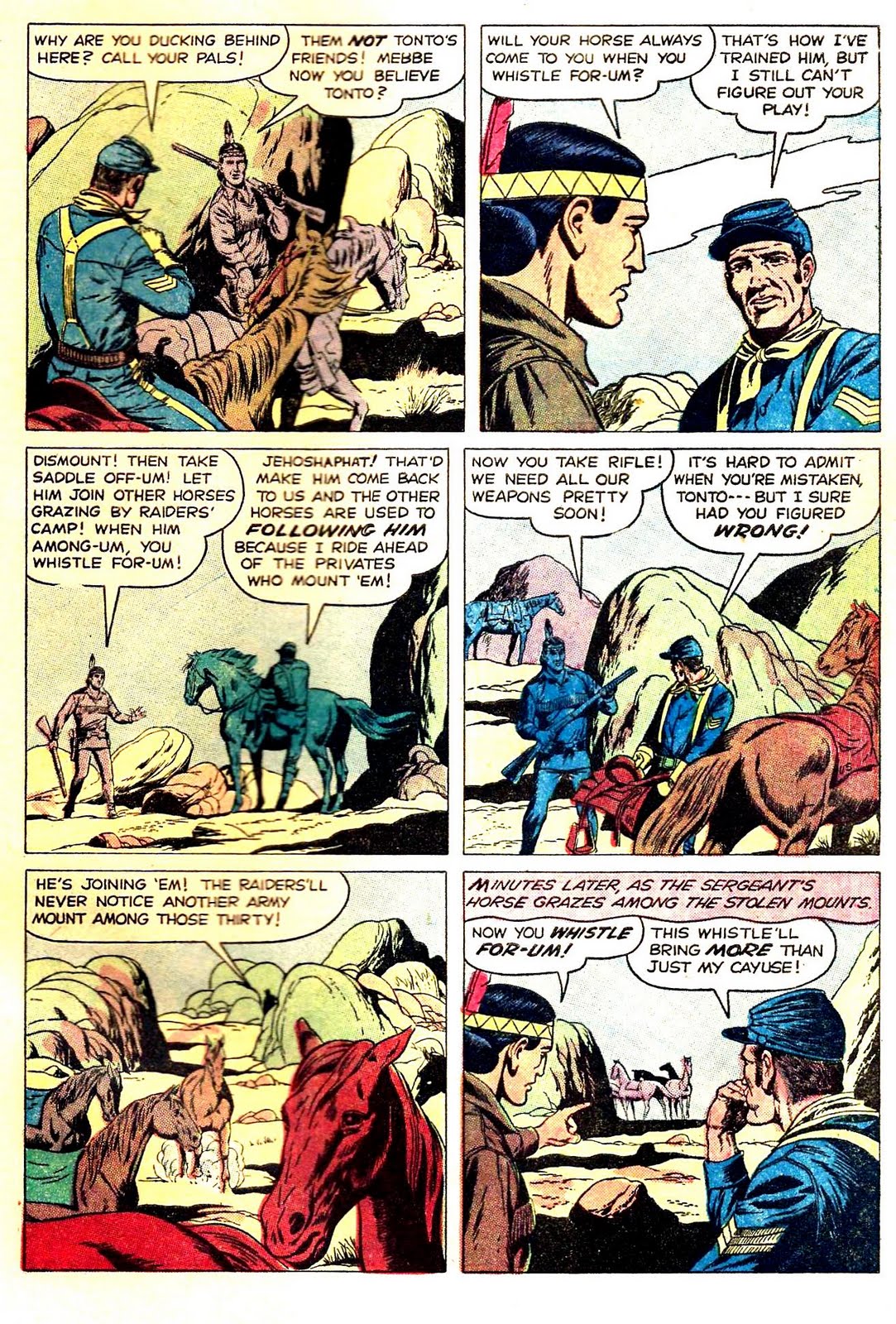
Who Was That Masked Man's Injun Companion?- Tonto #19


Yep, that's right. Tonto had his own series. And really, out of all the partners and sidekicks of western heroes, who is more deserving? Red Ryder's kid sidekick Little Beaver? Well, okay, Dell gave him a comic, too. Of course Beav's comic only lasted 6 issues. Tonto's lasted 33. Which is pretty good for a spin-off. Sadly, Dell's comic about "The Lone Ranger's Famous Horse, Hi-Yo Silver!" lasted 34 issues. Sorry Tonto.

Here we have the cover story (although the cover art has nothing to do with it) from The Lone Ranger's Companion TONTO #19 from May-July 1955. Oh! and when you get to page 16, no need to adjust your sets, that page IS black and white. Dell made use of the inside and outside back cover to finish the story.